

There are few things in this world more essential than water. As much as it may hurt to go more than a week without seeing your significant other or watching your favorite show, you will in fact survive. When it comes to going a week without water, however, your chances of survival become a lot slimmer. Hence, the combination of chemicals we call H2O is not only refreshingly delicious but also a human necessity.
Even so, as essential as water is to our very existence, many populations in the United States don’t have regular access to clean water sources. What should be a guarantee has now become a privilege for some as they struggle to attain this resource many take for granted.
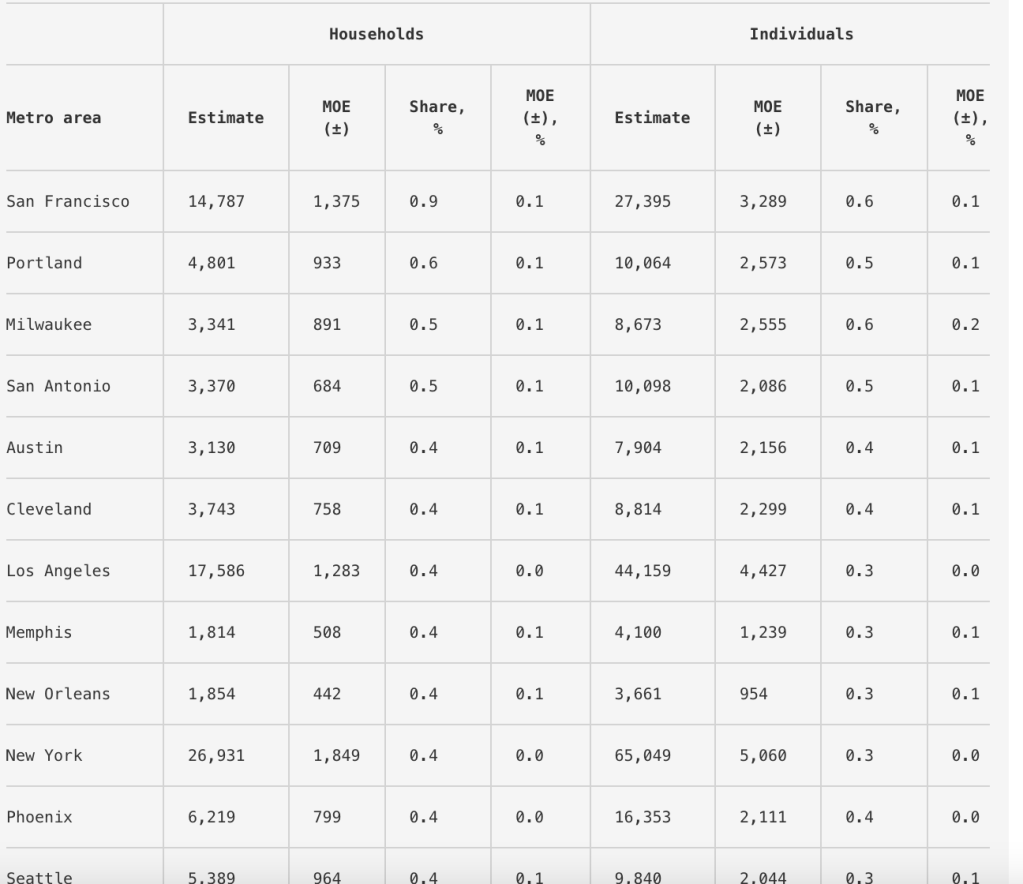
In a study published by the Proceedings of the National Academy of Sciences of the United States of America, researchers were able to break down the logistics of unequal access to water within this country. Their findings were that most clean water access issues boiled down to lack of water piping within households. Without this at-home infrastructure easily providing clean water, individuals were left with very few options as to where to turn next.
One of the most revealing aspects of this study was that most populations that lacked clean water access lived amongst the country’s top 50 metropolitan cities. Before conducting this research, I assumed that cities would not struggle with this issue as much since there is such a large congregation of buildings and businesses that could potentially distribute clean water, as compared to more rural locations where populations are forced to be more self-sufficient. However, the study revealed that in actuality urban populations are the ones without clean water, specially metropolitan cities in the Southern and Western regions of the U.S.
As someone who lives in a metropolitan city, this made me reconsider the water access within my own community. I admit that the majority of my water usage sprouts from the facilities available within my apartment building. Thus, for those who do not have access to water piping, it could be cumbersome to find establishments that offer clean water. This becomes even tougher when you step outside areas surroundings college campuses as my university campus is the only other public space I use to refill my water bottle. For those that do not have access to college resources, the task to find water can be quite stressful. Even with water piping, there is still a matter of cleaning the water so it’s safe for consumption. One of the first items I had to buy when moving into my apartment was a Brita water filter so my roommate and I would have safe drinking water. This is yet another hoop for populations to jump through when struggling to access clean water.
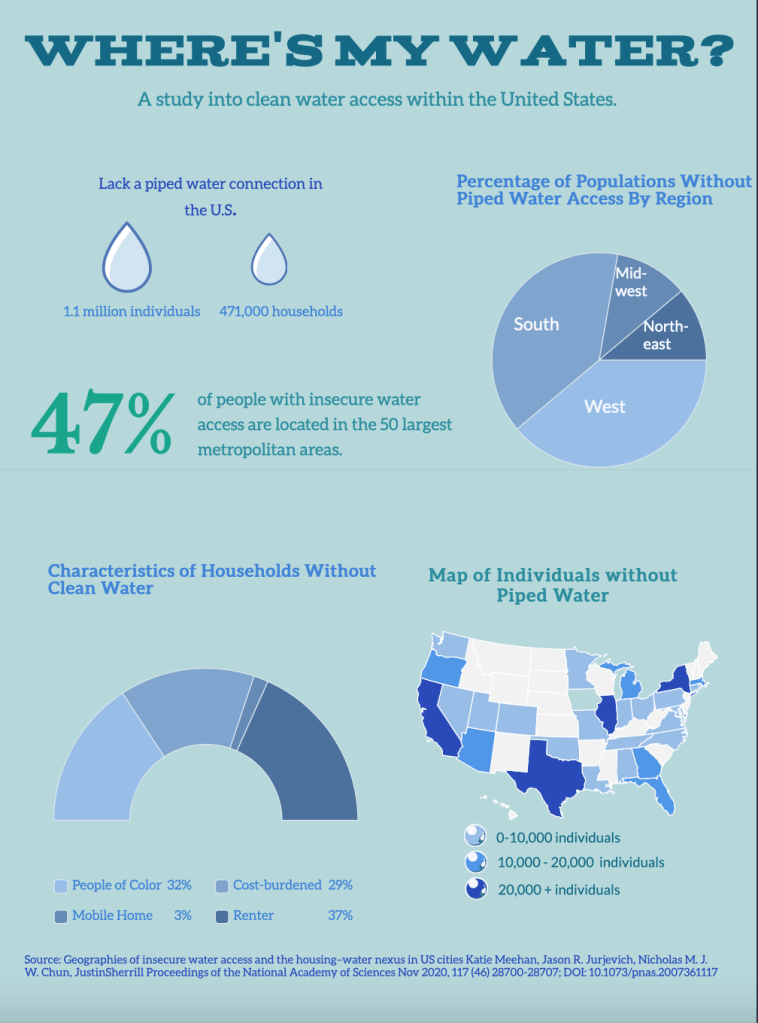
The research article noted some characteristics of the households that lacked water piping, and thus, access to clean water. Researchers found that a large percentage of these households were occupied by people of color. This statistic made me think of the water crisis in Flint, Michigan where residents of the predominantly-Black town went years without access to clean water as government officials ignored their petitions for change. When it comes to issues that plague populations of color, it oftentimes takes far too long for someone to care enough to enact a solution.
Other characteristics of households without water piping were that many of them were renters as opposed to buyers and they were burdened by the cost of living. This suggests that perhaps individuals without access to water are facing this challenge because of the conditions of a building they do not even own. When renting, issues with water piping are oftentimes out of the renters’ control, and thus they must rely on landlords for basic necessities. Cost-burdened populations are also more likely to carry the weight of other essentials like electricity and transportation and causing water to only add to the stress and possibly fall to the bottom of their checklist.
Learning about water accessibility has taught me to not take for granted the clean water I have readily available. In the infographic below, I further examine this issue within this U.S. and add a visual element to show just how many people do not have the privilege of pouring a glass of water anytime they need it.
Made with Visme Infographic Maker
 nyah terrilyn